


For financial advisors and RIAs, a Section 351 exchange can look like a powerful way to move appreciated client portfolios into an ETF without triggering immediate gain. The opportunity is real, but the rules are narrow. A successful transaction depends on control, asset eligibility, diversification, documentation, and client consent.
This section 351 exchange financial advisor guide explains the practical rules advisors need to understand before recommending an ETF conversion strategy. We cover the core tax requirements, the 25 and 50 diversification test, eligible and ineligible assets, account aggregation, operational records, and advisor responsibilities. We also flag the places where the answer depends on the client, the portfolio, or the fund structure, which means consult your tax advisor.
What a section 351 exchange financial advisor needs to know
Section 351 generally allows a person to transfer property to a corporation solely in exchange for stock in that corporation without recognizing gain or loss, if the transferor or transferors are in control immediately after the exchange. The core rule comes from IRC Section 351(a).
For ETF conversions, the corporation is typically the newly launched ETF or fund structure receiving the contributed securities. The client gives property to the fund and receives ETF shares in return.
The most important limitation is control. Immediately after the exchange, the transferor group must own at least 80 percent of the total combined voting power and at least 80 percent of the total number of shares of all other classes of stock. That control definition comes from IRC Section 368(c).
This is why Section 351 is usually discussed in the context of seeding or launching a new ETF. It is not usually a simple path for contributing appreciated securities into an existing ETF.
Section 351 exchange financial advisor rule number one
The transaction must be an exchange of property solely for stock. That means the client contributes property and receives stock in the corporation. If the client receives other consideration, the tax result can change under IRC Section 351.
For advisors, this rule turns a marketing idea into a documentation project. The contribution agreement, client records, ETF formation documents, and transfer mechanics must support the basic exchange structure.
The transfer also needs a real business and investment purpose. If the plan is to contribute assets and then immediately sell them outside the ordinary course of portfolio management, the transaction may raise concerns. Consult your tax advisor when there is any planned post contribution sale program.
Callout box
A Section 351 exchange is not just an asset transfer. It must be a transfer of property to a corporation solely for stock, with the transferor group in 80 percent control immediately after the exchange under IRC Section 351(a) and IRC Section 368(c).
The 25 and 50 diversification test
A transfer to an investment company can be taxable if it results in diversification of the transferor’s interests. This limitation is found in IRC Section 351(e), with related rules in Treasury Regulation Section 1.351-1(c).
In practice, the contributed portfolio must already be diversified before the exchange. The common test is the 25 and 50 test. No single holding should represent more than 25 percent of the contributed portfolio value, and the top five holdings together should not exceed 50 percent of the portfolio value.
Cash does not solve concentration. Cash and cash items are excluded from the total assets denominator for this purpose under the rules described in Treasury Regulation Section 1.351-1(c). That means a client generally cannot add cash to make a concentrated stock position appear diversified.
Government bonds can be helpful diversifiers because they count in total assets but are not treated as securities of an issuer in the numerator. However, buying diversifying assets right before the transaction only to pass the test can create tax risk. Consult your tax advisor before relying on any last minute portfolio changes.
Look through rules for ETFs and funds
If a client contributes ETFs, regulated investment companies, or closed end funds, the diversification analysis may look through to the underlying holdings. This prevents a portfolio from appearing diversified only because it holds a wrapper around concentrated positions. The investment company limitation is governed by IRC Section 351(e) and Treasury Regulation Section 1.351-1(c).
This matters for advisors who manage model portfolios that already include ETFs. A client may appear to hold a clean basket of diversified funds, but the underlying exposures can overlap.
Share classes should also be combined for diversification testing. For example, different share classes of the same company should not be treated as separate issuers for purposes of avoiding concentration.
This is a fact specific area. Advisors should gather holdings detail before assuming the portfolio passes.
Eligible assets for a Section 351 ETF conversion
Section 351 itself does not create a simple asset menu. It focuses on property transferred to a corporation in exchange for stock under IRC Section 351(a). In an ETF context, eligibility also depends on whether the assets can work inside the fund structure.
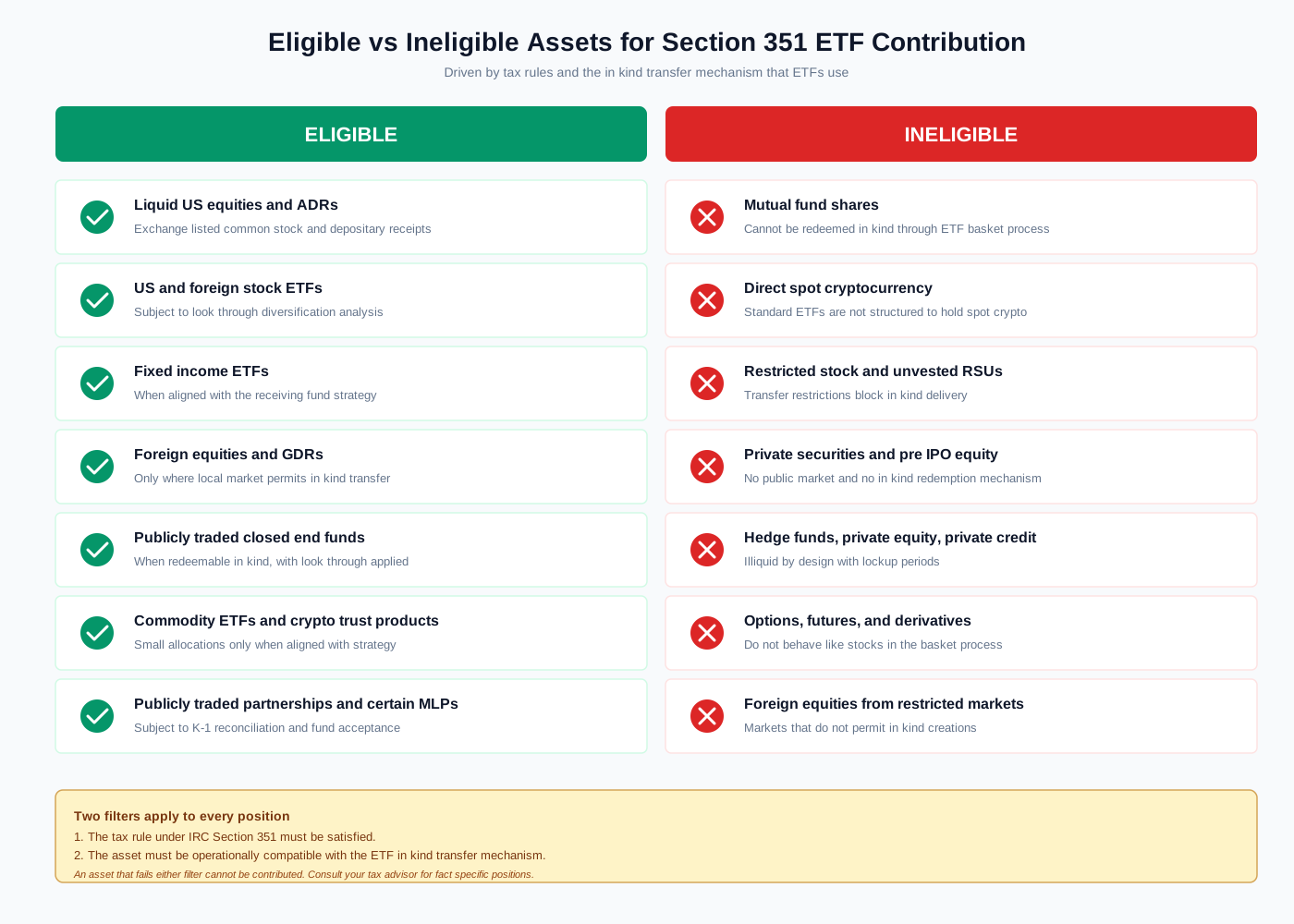
Generally acceptable assets may include liquid US equities, ADRs, US and foreign stock ETFs, fixed income ETFs, and certain publicly traded closed end funds. Foreign equities and GDRs may be acceptable only where the relevant market permits in kind transfers and redemptions.
Some assets may be accepted only in small amounts and only if they align with the ETF strategy. Examples can include commodity ETFs, spot crypto exposure held through an ETF or trust product, and publicly traded partnerships. These cases require operational review and consult your tax advisor.
The contributed basket must also align with the fund prospectus. A domestic equity ETF should not accept a portfolio that conflicts with its stated strategy.
Ineligible assets and common blockers
Some assets do not fit well in an ETF conversion because they cannot be transferred or redeemed in kind, create legal restrictions, or introduce tax problems. Mutual fund shares are generally not suitable because they usually cannot be traded in kind.
Direct spot cryptocurrency is generally not eligible for a standard ETF contribution unless the vehicle is structured to hold that asset directly. Private securities, restricted stock, RSUs, private equity, hedge fund interests, options, and other illiquid alternatives are generally excluded.
Foreign securities can also be blocked by local market rules. If a country does not permit in kind creations and redemptions, the asset may not be workable for the ETF basket.
Portfolios with net unrealized losses should be reviewed carefully. Section 351 generally carries over basis rather than stepping basis up, so a client may be better served by harvesting losses before any exchange. Consult your tax advisor before contributing loss positions.
Client consent and advisor duties
Advisors should obtain explicit written client consent before transitioning separately managed account assets into an ETF through a tax deferred exchange. The client should understand that the transaction is designed to be tax deferred, not tax free forever.
Client communications should explain the basic exchange, the ETF shares received, the carryover basis concept, and the key risks. They should also make clear that each client should consult your tax advisor.
Advisors also need to consider affiliated transaction rules when clients or advisors may be affiliated persons of the fund. Transactions involving affiliated persons and registered investment companies can raise issues under Section 17 of the Investment Company Act of 1940, including potential reliance on Rule 17a-7.
This is not just a tax workflow. It is also a fiduciary, disclosure, and operational workflow.
Basis records and account aggregation
Lot level records are essential. Custodians should provide purchase date and cost basis for every tax lot. Average cost basis data is not enough for a precise Section 351 conversion.
The reason is simple. The contributed assets generally carry over into the ETF structure rather than receiving a new stepped up basis. If the records are wrong, the tax consequences can be wrong.
Account aggregation also matters. Tax tests may apply at the taxpayer level, even if the advisor reviews accounts separately. A client contributing from an individual account, joint account, and trust account may need an aggregated analysis.
This is one of the easiest places to make a mistake. Before recommending a transaction, advisors should confirm ownership, taxpayer identity, account type, and records quality.
Account types that may not fit
Not every account should participate in a Section 351 ETF conversion. C corporations may create additional tax concerns, including potential double taxation or built in gain issues if appreciated assets are later sold.
ERISA accounts, including certain retirement plans, generally cannot transfer assets in kind without a specific Department of Labor exemption. Advisors should not assume that a tax rule alone makes the transaction operationally or legally permissible.
Trusts, joint accounts, and multi owner structures require special review. The diversification test, consent process, and tax reporting may depend on the owner and taxpayer facts.
When the account type is anything other than a straightforward taxable account, consult your tax advisor.
Practical checklist for RIAs
A strong advisor process starts with screening. Confirm the client owns appreciated assets, the portfolio is diversified, and the assets are compatible with the proposed ETF strategy.
Next, review the 25 and 50 test, including look through holdings for ETFs and regulated funds. Exclude cash from the denominator and combine share classes of the same issuer.
Then confirm lot level basis data, account ownership, client consent, and any affiliated transaction issues. The transaction should be documented as a transfer of property solely for stock under IRC Section 351(a), with the transferor group satisfying control under IRC Section 368(c).
Finally, avoid pre arranged sales that make the contribution look like a short term liquidation plan. Ordinary portfolio management after launch is different from a pre established plan to dispose of contributed assets. Consult your tax advisor when the fund expects meaningful early trading.
Conclusion
A Section 351 ETF conversion can be valuable for advisors managing appreciated taxable portfolios, but it is not a shortcut around tax rules. The transaction must satisfy the property for stock exchange rule, the 80 percent control requirement, and the investment company diversification limits under IRC Section 351 and related Treasury regulations.
The next step is to screen each client portfolio before discussing implementation. Start with asset eligibility, 25 and 50 diversification, account type, lot level basis records, and written client consent. Then involve tax counsel before any transfer documents are signed.