

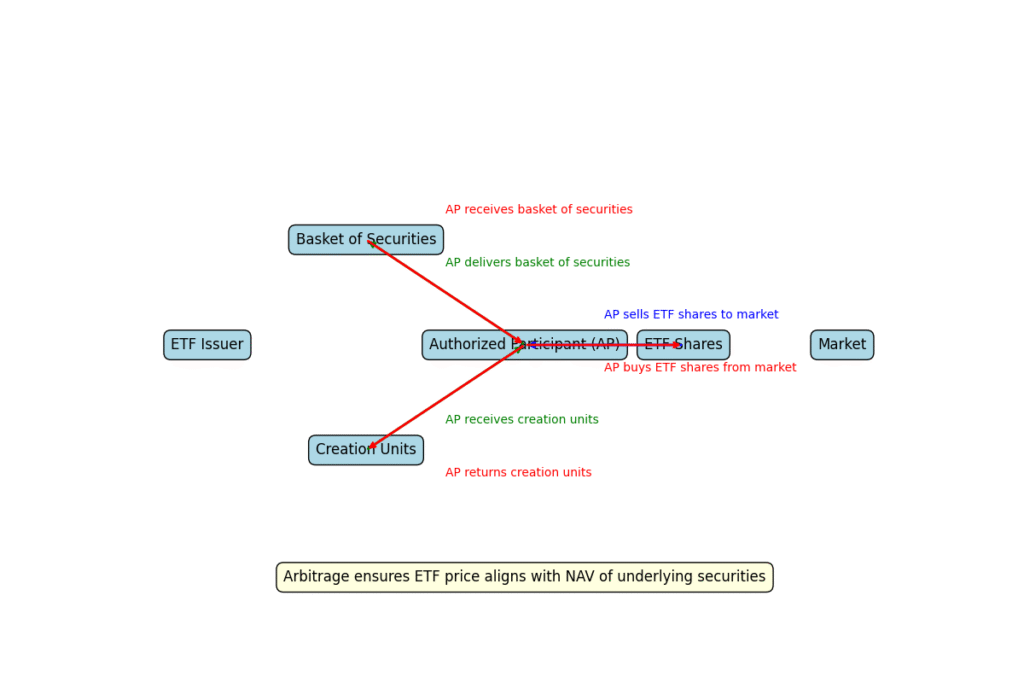
The creation and redemption mechanism is what makes ETFs liquid, tax-efficient, and fairly priced—even during market volatility.
What Are Authorized Participants?
Authorized Participants (APs) are large financial institutions—typically broker-dealers—with exclusive rights to create or redeem ETF shares directly with fund companies. They trade in large blocks called creation units (usually 25,000-100,000 shares) and work with market makers to provide exchange liquidity.
How Creation Units Work
APs exchange standardized blocks of ETF shares for baskets of underlying securities that mirror the ETF’s portfolio. This basket might include stocks, bonds, or other assets, plus small cash amounts for balancing.
The Arbitrage Process Keeps Prices Fair
When ETF market prices drift from their Net Asset Value (NAV), APs step in to profit from and correct these discrepancies:
ETF Trading Above NAV (Premium)
- APs buy the underlying securities
- Deliver securities to ETF company for new creation units
- Sell new ETF shares at premium prices
- Increased supply drives ETF price down toward NAV
ETF Trading Below NAV (Discount)
- APs buy discounted ETF shares on exchanges
- Bundle shares into creation units and redeem with ETF company
- Receive underlying securities “in-kind”
- Sell securities at fair market value for profit
- Reduced ETF supply pushes price back toward NAV
This self-correcting mechanism ensures ETF prices stay close to their true underlying value.
Tax Advantages Through In-Kind Transactions
ETFs achieve superior tax efficiency because they transfer actual securities—not cash—during redemptions. Under Section 852(b)(6) of the tax code, these in-kind redemptions don’t trigger taxable gains at the fund level.
ETF managers can strategically distribute low-cost-basis securities during redemptions, further reducing tax burdens and improving after-tax returns for investors.
Custom Baskets Add Management Flexibility
SEC Rule 6c-11 allows ETFs to use custom baskets that don’t exactly match their portfolios. This gives managers tools to:
- Rebalance without creating taxable events
- Adjust holdings when indexes change
- Manage actively managed ETF exposures efficiently
Heartbeat Trades for Tax Management
Some ETFs use coordinated creation and redemption flows with APs to dispose of appreciated securities tax-free. These heartbeat trades appear as sharp spikes in fund flows but serve as legitimate tax management tools.
Why This Matters for Investors
The creation and redemption process delivers three key benefits:
- Fair pricing through automatic arbitrage correction
- High liquidity via AP and market maker activity
- Tax efficiency through in-kind transactions
Understanding this mechanism explains why ETFs have become essential portfolio building blocks for both individual and institutional investors.
Bottom line: This behind-the-scenes process makes ETFs one of the most investor-friendly investment vehicles available today.